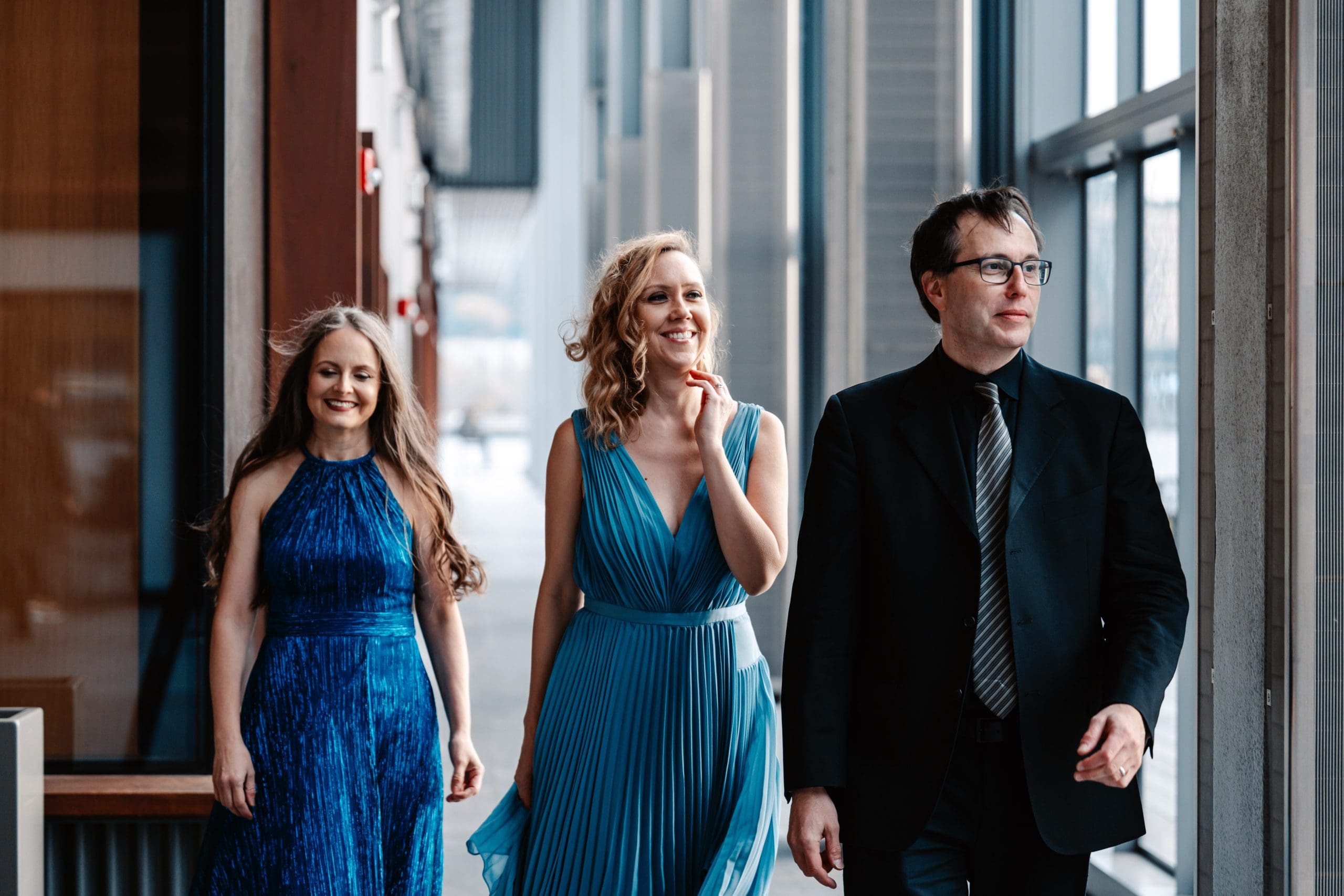
Salix Piano Trio
Sunday, September 20 at 2:00pm

Presented by Duke Arts Presents

“Personal and profound”
BBC Music Magazine
Three brothers named “Schumann,” joined by violist Veit Hertenstein, turned a family pastime into an internationally acclaimed quartet. “Fire and energy. The Schumann Quartett plays staggeringly well…without doubt one of the very best formations among today’s abundance of quartets, with virtuosity and a willingness to astonish” (Süddeutsche Zeitung).
“We really want to take things to extremes, to see how far the excitement and our spontaneity as a group take us,” says Ken Schumann. The concert gets underway with a late masterpiece by Haydn, the “father of the string quartet,” before taking a left turn into a marvelous rarity, the String Quartet No. 2 by Charles Ives. An early 20th-century American masterwork, the Ives Quartet conjures a political argument between four bullheaded personalities while skipping through popular American folk songs. To close the evening, the Schumann players probe a more intimate side of Russian composer Pyotr Ilyich Tchaikovsky in his String Quartet No. 1.
VENUE
Baldwin Auditorium
1336 Campus Drive
Durham, NC 27705
Visit our Baldwin Auditorium FAQ page for more information.
Venue DetailsRUN TIME
Approximately 1 hour and 20 minutes
Tickets available starting at $35. Student tickets always $10.
Haydn: Quartet in F Major, Op. 77, No. 2
Ives: Quartet No. 2
Tchaikovsky: Quartet No. 1 in D Major, Op. 11
*Program is subject to change
The Schumann Quartett has reached a stage where anything is possible, because it has let go of certainties. That includes the audience, which from one concert to the next have to be prepared for all eventualities: “A work really develops only in a live performance,” the quartet says. “That is ‘the real thing’, because we ourselves never know what will happen. On the stage, all imitation disappears, and you automatically become honest with yourself. Then you can create a bond with the audience – communicate with it in music.” In the near future, their live performances will be enriched by collaborations with artists such as Andreas Ottensamer, Kit Armstrong, Anna-Lucia Richter, Sabine Meyer, Katharina Konradi, Sharon Kam, and Alexey Stadler.
Highlights of the 2025/2026 season include performances in prestigious venues such as the Musikverein Vienna, the Elbphilharmonie Hamburg, the Muziekgebouw Amsterdam, the Cologne Philharmonie, and the Konzerthaus Dortmund. The quartet will also appear at renowned festivals including the Schleswig-Holstein Music Festival, the Mozartfest Bath, and the String Quartet Festival of the Heidelberger Frühling – to name just a few.
In February, the third edition of their project “Expedition Mozart” with Kit Armstrong will take place, featuring concerts in Salzburg and La Chaux-de-Fonds. The season concludes with a chamber music tour alongside Lisa Batiashvili in July 2026.
The quartet’s third album, Intermezzo (2018), featuring works by Felix Mendelssohn Bartholdy, Robert Schumann, and Aribert Reimann – recorded in collaboration with soprano Anna-Lucia Richter – was praised nationally and internationally, and received the 2019 Opus Klassik Award in the category of Chamber Music Recording. In 2020, the ensemble expanded its discography with Fragment, a powerful exploration of the work of one of the great masters of the string quartet: Franz Schubert.
To mark the 100th anniversary of radio broadcasting, the quartet undertook a unique project: in autumn 2023, they released an album entirely dedicated to the music of the year 1923. Created in collaboration with Bayerischer Rundfunk, the much-praised recording features works by Alban Berg, Leoš Janáček, Paul Hindemith, and Aaron Copland.
The three brothers Mark, Erik and Ken Schumann have been playing together since their earliest childhood – meanwhile violist Veit Hertenstein completes the quartet. The four musicians enjoy the way they communicate without words, and although the individual personalities clearly manifest themselves, a common space arises in every musical work in a process of spiritual metamorphosis. The quartet’s openness and curiosity may be partly the result of the formative influence exerted on it by teachers such as Eberhard Feltz, the Alban Berg Quartet, or partners such as Menahem Pressler.
Awards, CD releases – it is always tempting to speculate on what factors have led to many people viewing the Schumann Quartet as one of the best in the world. But the four musicians themselves regard these stages more as encounters, as a confirmation of the path they have taken. “We really want to take things to extremes, to see how far the excitement and our spontaneity as a group take us,” says Ken Schumann, the middle of the three Schumann brothers. They charmingly sidestep any attempt to categorise their sound, approach or style, and let the concerts speak for themselves.
And the critics approve: “Fire and energy. The Schumann Quartet plays staggeringly well […] without doubt one of the very best formations among today’s abundance of quartets, […] with sparkling virtuosity and a willingness to astonish” (Harald Eggebrecht in Süddeutsche Zeitung).
Erik Schumann plays the violin ”Auer, Benvenuti“ by Antonio Stradivari, Cremona 1699, kindly loaned by a German foundation. Ken Schumann plays an old Italian violin from the mid-18th century, kindly made available to him privately. Veit Hertenstein plays a viola made by the Amati brothers in 1616. Mark Schumann plays a cello by Giovanni & Francesco Grancino from 1680, generously loaned to him by MERITO Sit Vienna.
Schumann Quartett’s Website | Facebook | Instagram
Chamber Arts Subscriptions: All 8 concerts for $300, 7 for $262.50, and 6 for $225.
Pick-4 Packages: Book 4 or more shows and save 20%.
Single Tickets Available Now!
*Please note: For online Pick-4 orders, seats are automatically chosen based on best availability. To choose specific seats or price levels, please call the Box Office at 919-684-4444.
Tier 1: $47
Tier 2: $35
Students*: $10 (Log in through Shibboleth to access Duke-exclusive discounts)
Duke Employees: 25% Off (Log in through Shibboleth to access Duke-exclusive discounts)
*All high school and college students are eligible for student tickets with valid ID shown at event.


