
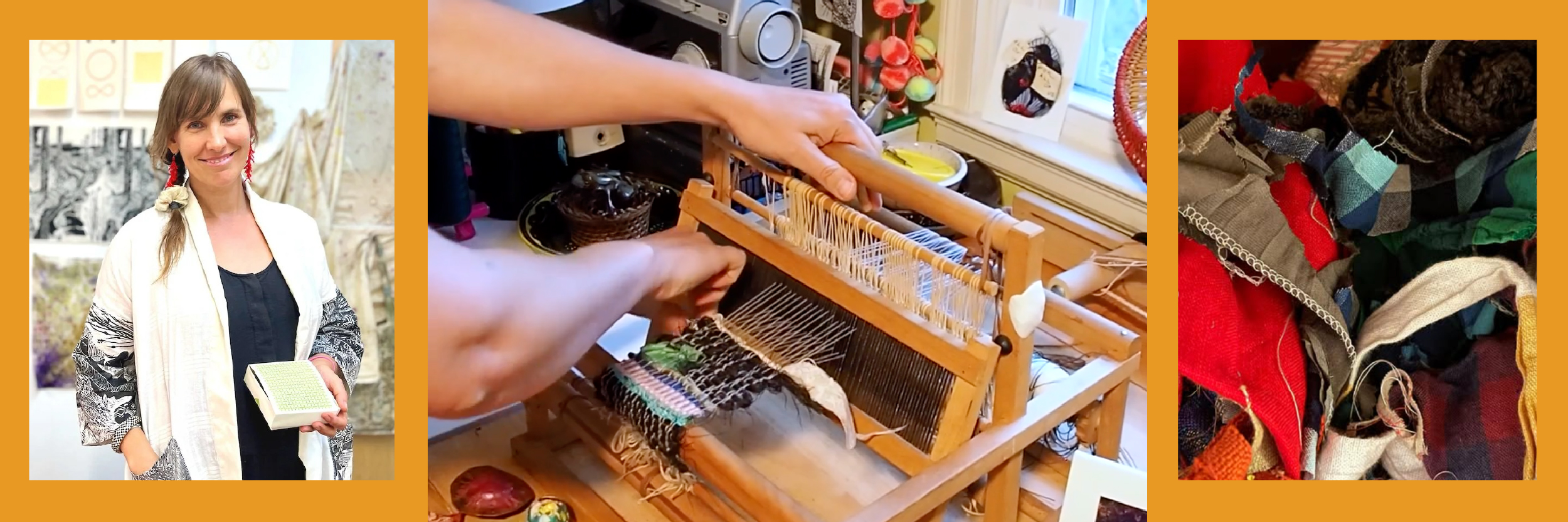
We are excited to feature Amelia Shull, multidisciplinary artist and educator, in our new Art of Renewal series. This series spotlights how Duke Arts Create instructors incorporate sustainability into their creative practice and offers ideas for incorporating reuse and other sustainable approaches into everyday art-making.
When Durham-based artist Amelia Shull imagines walking into her dream clothing store, every rack is already teeming: so full that fabric spills from the hangers, surrounding her with every color, every texture and every style one could possibly dream of. Only, in this clothing store, none of the clothes are new. Every thread has lived a past life: a tablecloth, a curtain drape, a sweater, each one a scrap that has found a new purpose.
That is the world that Shull believes in: a world where art begins not with the swipe of a card and the purchase of new material, but with the reflection and reimagination of the materials that we already have. “There really are enough clothes for everyone,” she explains. “ In a lot of ways, it’s hard for me to believe that we even need any new stores for new clothing. The amount of fabric and clothing waste that goes into the landfill is absurd and embarrassing for us as humans.”
Shull, also an educator who teaches free hands-on arts workshops through Duke Arts Create, is quietly redefining what it means to make art in a culture obsessed with consumption. Her work primarily centers on the concept of fabric reuse, transforming discarded textiles into woven garments, accessories and even book covers. For her, sustainability is not a trend or a marketing term to encourage more profit, but a way of thinking, feeling and connecting.
“In a lot of ways, it’s hard for me to believe that we even need any new stores for new clothing.”
Amelia Shull, Durham-based artist and duke arts create instructor

Her journey began as a child, at her grandmother’s kitchen table. “I’d get off the school bus and she’d be sewing or cooking,” Shull recalls. “And so that was something that I did with her a lot… sewing has just been something that I’ve appreciated and enjoyed as an extra level of self-expression.” Those afternoons with her grandmother planted the seeds of a lifelong habit of turning the ordinary into something extraordinary. Curtains became shirts, old sweaters unraveled into yarn and paper was twisted into thread and fibers for weaving. With Shull, the unconventional finds utility in a new purpose. Everything can be remade, you just have to look at it through a different lens.
Over time, Shull’s artistry evolved from simply mending clothes to weaving entirely new textiles. Today, she sources almost all her materials secondhand, from Durham’s Scrap Exchange to thrift stores to neighborhood swap meets. Even the byproducts of her own projects, tiny serger trimmings and fabric edges, find new life as woven cuffs, collars or jewelry. “When I sew a jacket, I save the scraps,” she explains. “Then I weave them into something that belongs to it.” In every project’s scraps, Shull finds a new accessory that somehow always completes the story.
That sense of storytelling carries into her teaching as well. In her Duke Arts Create workshops, spanning watercolor, zine-making, and mindful weaving, Shull treats creativity as a form of rest and reclamation. “It always feels a little like a yoga class,” she says with a grin. “Just showing up for yourself as a creative human is a real gift that we don’t always give ourselves. So I always hope that when folks show up, they not only learn something that could be something new in their life that’s a practical or creative outlet for them, but they also recognize that they’re creative humans, no matter what the outcome is.”
But Shull is also candid about the contradictions within sustainability. “It’s not lost on me that I have access: to thrift stores, to materials, to time,” she reflects. “So I try to teach ways of making that cost almost nothing: mending, reusing, skill-sharing.” In Shull’s creative philosophy, sustainability is not about perfection, but about participation.
“Just showing up for yourself as a creative human is a real gift that we don’t always give ourselves.”
Amelia Shull, Durham-based artist and duke arts create instructor

For her, community is the most renewable resource there is. Duke Arts, she says, helps amplify the message she has for artists by offering free materials and open workshops. Shull has found that when people come together to learn and create, it becomes not just about the art, but about building relationships that last.
At the heart of Shull’s philosophy is a belief that art and environmental justice are truly intertwined. Through her words, she crafts a meaningful image: “A lot of artists in North Carolina started the environmental justice movement, laying down their bodies in the road to stop environmental harm. So there are ways that we can use our bodies, our clothes, our forms of expression, the messages and slogans on the shirts we wear, on banners we sew, to make our hopes for a more environmentally sustainable world visible.”
In her studio, endless loops of salvaged yarn hang from handmade looms. Each strand carries an old memory of the sweater, the bedsheet, the moment it once was, but together they form something new. Shull’s microcosm of controlled chaos echoes her philosophy back to any visitors: the world does not need any more clothes, just people who care enough to make meaning out of what is already here.


Keep up with Amelia on Instagram.
Learn more about Amelia’s creative work here.
This series is written and produced by Duke Green Devil interns Jenna Arafeh and Yuchen Chen, who are working with Duke Arts through the Duke Office of Climate and Sustainability internship program for the 2025–26 academic year.
History / Secondary School Teaching Licensure
May 2028

Biology / Visual & Media Studies and Religious Studies
May 2027
Duke Students & Employees save more!